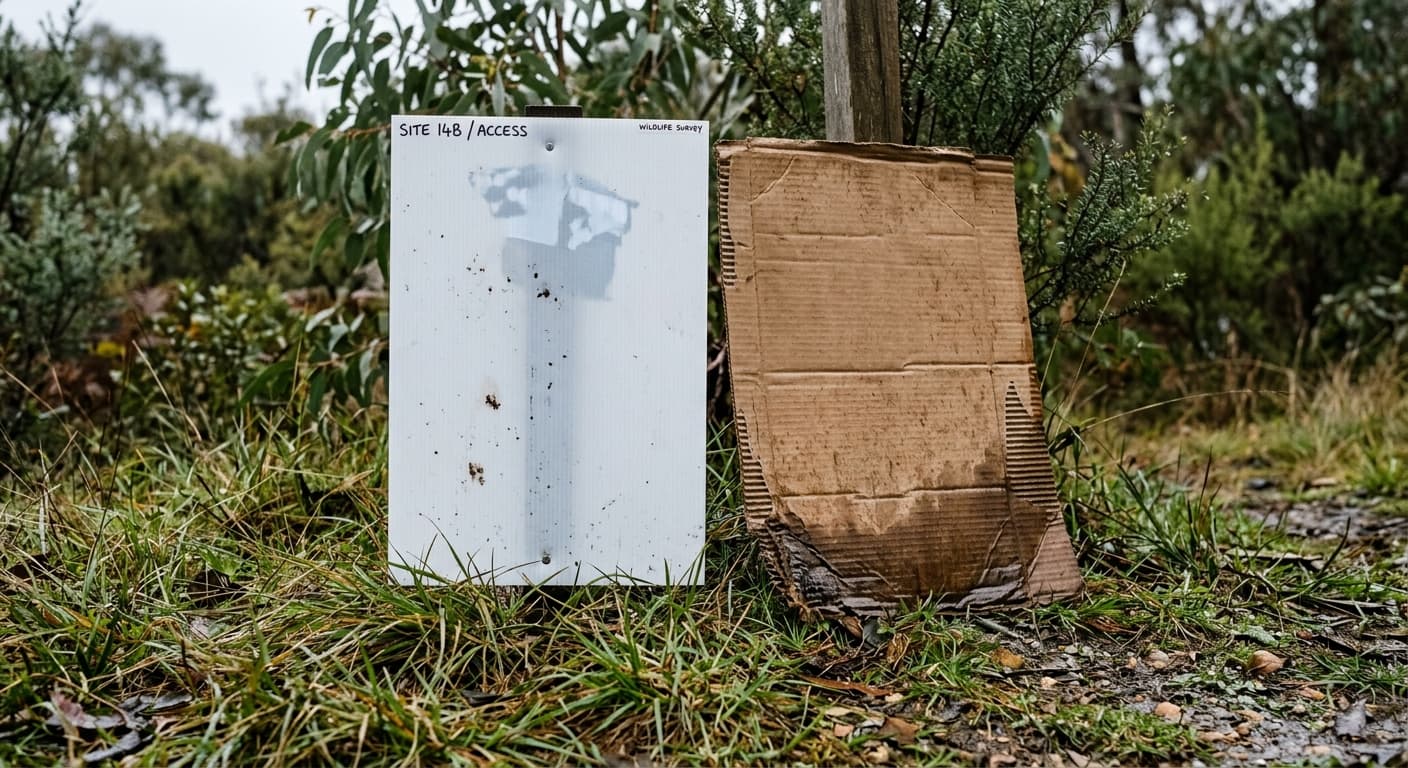
Corflute and corrugated cardboard share a design: two flat skins with a fluted core between them, giving stiffness at very low weight. The difference is the material. Corflute is polypropylene, so it is waterproof, reusable for years and survives outdoors. Cardboard is paper, so it is cheaper per sheet, prints beautifully, and turns to pulp the moment it gets wet. The choice comes down to a single question: will this ever get wet, and will it be used more than once? If yes to either, corflute wins on total cost even though it costs more up front. If it is a single-use indoor job and price per unit is the priority, cardboard is the better material.
Here is the full comparison across the five factors that actually decide it, and the situations where each one is clearly right.
What each material actually is
Corflute, also sold as corriboard, corriflute, Coroplast and simply corrugated plastic, is an extruded polypropylene sheet. Because it comes out of the die as a single piece, the flutes and skins are one continuous material rather than glued layers. Common thicknesses are 2mm, 3mm, 5mm and 10mm, and standard Australian sheet sizes are 1200 x 900mm and 2400 x 1200mm. “Corflute” is a registered trade mark of Corex Plastics in Australia, though it is used generically much like Esky or Biro.
Corrugated cardboard is made from paper liners glued either side of a fluted paper medium. It is classified by flute profile, with A, B, C, E and F flutes ranging from tall and cushioning down to fine and print-friendly, and by whether it is single wall, double wall or triple wall. Board strength is quoted as an edge crush test or bursting strength figure.
The core structural principle is identical in both. What differs is everything that happens when the material meets water, sunlight and repeated handling.
The comparison
| Corflute | Corrugated cardboard | |
|---|---|---|
| Material | Polypropylene | Paper |
| Water resistance | Waterproof, unaffected | Fails rapidly, loses all strength when wet |
| Outdoor life | 12 to 24 months typical, longer with UV additive | Days, and only if kept dry |
| Reuse cycles | Dozens to hundreds in closed-loop use | Typically one to a few trips |
| Cost per sheet | Higher | Lower, often several times cheaper |
| Cost per use | Very low where reused | Low only for genuine single use |
| Printing | Screen, digital UV and vinyl. Needs corona treatment for good ink adhesion | Excellent, flexo and litho, superb photographic reproduction |
| Chemical and grease resistance | High | Poor, absorbs and stains |
| Weight | Light, slightly heavier than equivalent board | Very light |
| Recycling | Recyclable as polypropylene but not through kerbside bins | Kerbside recyclable almost everywhere in Australia |
Durability and weather
This is the least close comparison of the five. Corflute shrugs off rain, humidity, mud and washing down with a hose. Corrugated cardboard is made of paper fibres held in shape by starch adhesive, and both fail on contact with water. A wet carton loses most of its stacking strength in minutes and does not recover on drying.
Outdoors, corflute typically gives 12 to 24 months of useful life before UV degradation makes it chalky and brittle at the edges. Sheets made with UV stabiliser additives run considerably longer. Cardboard outdoors is measured in days.
Indoors and dry, the gap narrows a lot. A cardboard display in a shopping centre or a carton in a dry warehouse will do its job perfectly well, and paying for plastic there is money spent on durability you never use.
Cost
Corflute costs meaningfully more per sheet. The correct comparison is not per sheet but per use.
For a single-use application, cardboard wins clearly and there is not much to debate. For anything reused, the arithmetic inverts fast. Take returnable transit packaging on a delivery run between two fixed sites. Cardboard cartons get crushed, damp and discarded within a handful of trips. Corflute totes in the same loop routinely last years, and manufacturers in closed-loop supply chains report life spans on the order of fifty times that of the cardboard equivalent. At even ten reuses the corflute is already cheaper, and it keeps going.
The same logic applies to signage. A corflute real estate sign that survives a wet season and gets reused on the next listing has already beaten a cardboard sign that would not have survived the first week.
Printability
Cardboard is the better print surface, and it is not close. Paper takes ink readily, holds fine detail and reproduces photography and gradients well through standard flexographic and lithographic processes. If your packaging is a brand asset that customers unbox, cardboard gives the better result.
Corflute prints well but has requirements. Polypropylene is a low surface energy plastic, meaning ink does not naturally want to stick. Print-grade corflute is corona treated at manufacture to raise surface energy, and that treatment decays over months. Old stock prints badly, which is the usual explanation when ink lifts off a corflute sign. Screen printing and digital UV printing both give durable results on treated sheet, and applied vinyl graphics are the most robust option of all, particularly for short runs.
One quirk worth designing around: corflute flutes run in one direction, and on close inspection the ribs show through solid colour areas. Specify flute direction when ordering. For a standard portrait real estate sign the flutes should run vertically so the sign resists sagging, and vertical flutes also shed water rather than trapping it in the channels.
Reuse and handling
Corflute can be scored and folded, die cut, welded, riveted, eyeletted and cable tied, and it will take that treatment repeatedly. Fold lines in polypropylene act as a living hinge and survive many cycles. It also washes down, which matters in food handling, horticulture and any application with hygiene requirements.
Cardboard folds cleanly the first time and progressively less well after that. Creases fatigue, corners soften and flute crush accumulates with every handling cycle. It is designed for a one-way trip and performs well in that role.
Recycling and environmental impact
This one is more nuanced than it first appears, and reasonable people land differently on it.
Cardboard has the obvious advantage of kerbside recyclability. Nearly every Australian council takes it, recycling rates are high, and it breaks down harmlessly if it escapes the system.
Corflute is recyclable, since polypropylene is a clean, widely recycled polymer numbered 5, but it must not go in a household kerbside bin. Large rigid sheets jam sorting equipment. It has to go through a dedicated stream: a resource recovery centre with a corflute drop-off, a specialist recycler, or a manufacturer take-back scheme. Several Australian councils and recyclers run corflute collection points, and election corflute recovery programmes have become a regular fixture after federal and state polls. Planet Ark’s Recycling Near You is the quickest way to find a drop-off in your area, and the Australian Packaging Covenant Organisation sets the national targets that increasingly shape what packaging buyers are expected to specify.
The environmental case for corflute rests entirely on reuse. A corflute tote used two hundred times almost certainly has a lower total footprint than two hundred cardboard cartons, even accounting for the plastic. A corflute sign used once and landfilled is worse than a cardboard one. The material is not the deciding factor; the number of uses is. If you buy corflute, plan for its second life.
When corflute is the right choice
- Outdoor signage of any kind. Real estate boards, election corflutes, construction site signage, event wayfinding, sponsor boards, A-frame inserts. Anything facing weather.
- Returnable transit packaging. Totes, dividers, layer pads and bins moving repeatedly between fixed sites.
- Wet, greasy or washdown environments. Horticulture trays, seafood and produce handling, workshop parts bins, anywhere a hose is involved.
- Surface protection during construction. Floor, lift and wall protection on site, where the sheet takes months of abuse, gets wet and is then reused on the next job.
- Longer-term temporary use. Anything needing to survive a full season rather than an afternoon.
When cardboard is the right choice
- Genuine single-use shipping. Ecommerce despatch, one-way freight, mail order. The cartons are not coming back.
- Retail packaging where print quality sells the product. Photographic imagery and premium unboxing.
- Indoor point of sale displays for a short campaign. Dump bins, counter units and floor stands for a promotion running a few weeks in a dry environment.
- Anywhere kerbside recyclability is a hard requirement. If the end user must be able to dispose of it in a household bin, cardboard is the only answer.
- Highest possible cost sensitivity at volume, with no reuse. Straightforward economics.
Specifying corflute properly
Four decisions cover most jobs.
Thickness. 3mm is the general purpose signage standard and suits most sizes up to about 900 x 600mm. 5mm is the choice for larger signs, anything freestanding, and packaging that carries load. 10mm is for heavy duty protection and structural packaging. 2mm suits small signs and lightweight inserts only.
Flute direction. Specify it, do not assume it. Vertical flutes for portrait signs, both for rigidity and for water drainage. For folded packaging, flutes must run parallel to the fold line so the crease becomes a hinge rather than a crush.
Print treatment. If it is being printed, order print-grade corona treated sheet and print it reasonably promptly. Untreated sheet, or treated sheet that has sat for a long time, will not hold ink.
UV grade. Standard sheet is fine for indoor use and short outdoor campaigns. For a sign expected to survive a full Australian summer in direct sun, specify UV stabilised.
Our stock and sizes are listed under corflute sheets and cardboard sheet, and there is a fuller walkthrough of thicknesses, sizes and applications in the complete guide to buying corflute sheets.
A note on using both
The two are not mutually exclusive and the best answer is often a mix. Cardboard outer cartons with corflute dividers inside gives you a recyclable, printable exterior and a reusable, crush-resistant interior. Cardboard for the one-way despatch legs of a supply chain, corflute for the closed-loop legs between your own sites. Corflute for the outdoor A-frame that lives in the weather, cardboard for the matching indoor counter display.
Choosing per component rather than per project usually costs less than committing to one material across the board.
FAQ
How long does corflute last outside?
Standard corflute typically gives 12 to 24 months outdoors in Australian conditions before UV exposure makes the surface chalky and the edges brittle. UV stabilised grades last considerably longer. The practical failure point is usually the fixing holes tearing out in wind rather than the sheet itself degrading, so use eyelets or a reinforced edge on anything cable tied to a fence.
Is corflute just plastic cardboard?
Structurally the design is the same, with two flat skins over a fluted core, and that is where the comparison is usually drawn. But corflute is extruded polypropylene in one continuous piece, while cardboard is glued paper layers. That makes corflute waterproof, washable and reusable many times over, where cardboard is a single-trip material that fails on contact with water.
Is corflute cheaper than cardboard?
Not per sheet. Corflute costs more up front, often several times more. It becomes cheaper on a cost-per-use basis wherever the item is reused, and the crossover typically arrives within about ten uses. For genuine single-use applications, cardboard is and remains the cheaper option.
Can corflute go in the recycling bin?
Not the household kerbside bin. Corflute is polypropylene and is fully recyclable, but large rigid sheets jam kerbside sorting equipment and are rejected. Take it to a resource recovery centre with a corflute drop-off point, a specialist polypropylene recycler, or a manufacturer take-back scheme. Several Australian councils run dedicated corflute collection, particularly after elections.
Which is better for real estate and election signs?
Corflute, without qualification. Both applications involve weeks or months outdoors in all weather, and both benefit from reuse across multiple campaigns or listings. Cardboard would not survive the first rain. Use 5mm with vertical flutes and eyelets at the fixing points for signs that will be cable tied.
Can you print photographs on corflute?
Yes. Digital UV printing on corona treated print-grade sheet gives good photographic reproduction, and applied vinyl graphics give the best result of all for short runs. Be aware that the flutes will show faintly through large areas of solid colour, so avoid designs that depend on a perfectly flat solid background. For genuinely premium photographic reproduction, cardboard or a smooth PVC board is the better substrate.