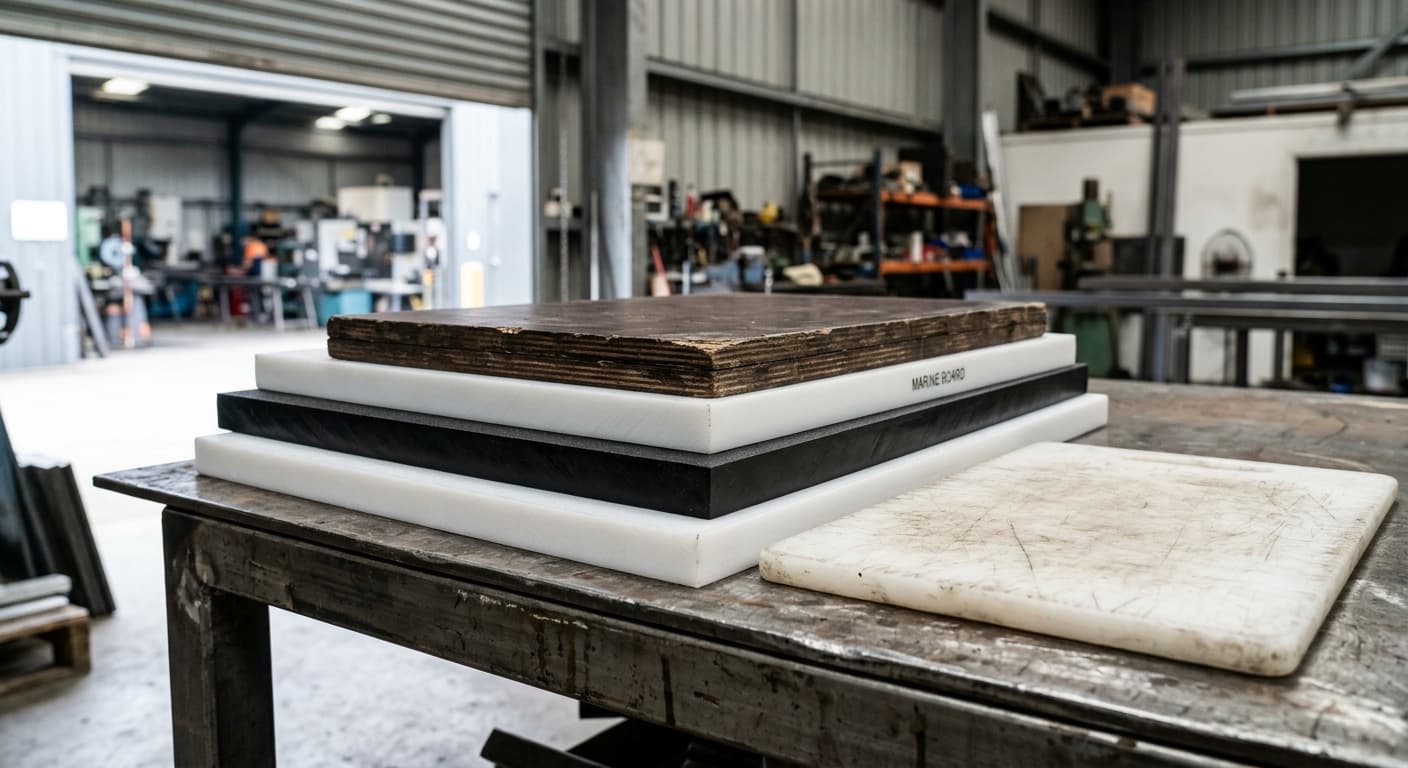
HDPE is used for anything that has to survive chemicals, water, impact and weather without complaint. In Australia that means chemical storage tanks and bunds, commercial chopping boards and food preparation surfaces, marine bollards and dock fenders, wear strips and slide rails in mining and materials handling, playground equipment, outdoor signage, cubicle dividers in wet areas, and greywater and rainwater tanks. It is the plastic industry reaches for when the part will be abused.
The reason is a short list of properties that rarely appear together in one material. HDPE resists almost every common acid, base, salt and solvent. It is food safe in standard grades. It absorbs no water at all and floats. Its surface is naturally low friction, so it slides without lubrication. And it can be heat welded, which makes large fabricated assemblies like tanks and bunds practical rather than theoretical.
This article is about where those properties get used and why. If you are choosing between HDPE and polypropylene specifically, we have a separate piece on HDPE versus polypropylene sheets that goes through that comparison properly.
What HDPE is
High-density polyethylene is a thermoplastic made by polymerising ethylene under conditions that produce long, largely unbranched polymer chains. Those straight chains pack together tightly, which is where the “high density” comes from and why HDPE is stiffer, stronger and more heat resistant than its low-density cousin, LDPE. You will also see it sold as PE 300 and PE 500, which are density and molecular weight grades rather than different materials.
The practical numbers for sheet:
- Density around 0.95 g/cm3, which is less than water, so it floats.
- Tensile strength around 25 to 30 MPa.
- Continuous service temperature to approximately 80 degrees Celsius.
- Water absorption effectively zero.
- Common sheet thicknesses from 3 mm through to 50 mm.
HDPE is also resin identification code 2, one of the most widely and successfully recycled plastics in Australian kerbside systems. Post-consumer HDPE from milk bottles and detergent containers has real reprocessing value, which is part of why HDPE remains a preferred material as packaging targets tighten.
Where industry actually uses it
Chemical storage and containment
HDPE’s chemical resistance is the property that opens most doors. It shrugs off acids, alkalis, salt solutions, alcohols and most solvents, and it does so without the surface degradation, softening or stress cracking that catches out other plastics. That makes it the default for chemical storage tanks, bunds, drip trays, dosing tanks and pipework in water treatment, agriculture, aquaculture and food processing.
The weldability compounds the advantage. Because HDPE can be joined by heat welding with a matching filler rod, a fabricator can build a rectangular bunded tank to a specific footprint out of sheet, rather than forcing the site to fit a moulded cylindrical vessel. Repairs work the same way, which means a cracked tank can usually be welded back into service instead of replaced.
Food processing and hospitality
Standard HDPE is food safe by composition, with certified FDA and EU food contact grades available where a specification demands documentation. Combined with zero water absorption and a surface that machines cleanly and does not splinter, that makes it the standard material for commercial chopping boards, food preparation benches, cutting and packing surfaces, and bakery and butchery fittings.
It is the reason nearly every professional kitchen board is white or coloured HDPE rather than timber. It will not harbour moisture, it can be run through a commercial dishwasher, and when the surface eventually gets scored it can be resurfaced or the board simply replaced at low cost.
Marine and boating
“HDPE marine board” is the same base polymer in a UV-stabilised, usually textured, often colour-through grade intended for permanent outdoor and saltwater exposure. It is used for bollards, dock fenders, rubbing strips, boat hatches, deck hardware, seating, bait boards, transom pads and trim.
The appeal is straightforward: it does not rot, does not corrode, does not absorb water, does not need painting or sealing, and floats if you drop it over the side. Where marine ply needs annual attention and aluminium needs galvanic consideration, HDPE needs nothing. Boat builders and refitters use it for exactly the components that would otherwise become a maintenance item.
Mining, materials handling and wear parts
HDPE’s low coefficient of friction means it slides against steel, itself and bulk material without lubrication. Add abrasion resistance and impact toughness that holds up in cold conditions, and you get the standard material for wear strips, slide rails, guide blocks, chute liners, conveyor wear pads, pulleys, skid plates and undertrays.
It is also non-sparking and electrically insulating, which matters in some mining and processing environments. And because it can be CNC routed to tight tolerances in thick sections, replacement wear components can be cut to match an existing part rather than sourced from an OEM.
Playgrounds, public space and wet areas
UV-stabilised HDPE with colour running through the full thickness is the material behind most modern playground panels, climbing components and outdoor bench seating. Scratches do not show a different colour underneath, graffiti can be cleaned or sanded off, and the material stays serviceable through years of Australian sun.
The same reasoning drives its use for toilet and shower cubicle partitions in pools, gyms, schools and surf clubs. Timber and particleboard fail in permanently wet environments. HDPE does not absorb moisture, so it does not swell, delaminate or grow anything.
Signage and general fabrication
Outdoor signage, bollard covers, equipment guards, spacers, packers, template jigs and one-off machine parts all get made from HDPE because it is cheap per kilogram, easy to machine, dimensionally stable and effectively weatherproof. It is a workshop staple more than a specified engineering material in these applications, but it is a staple for good reason.
The limitations worth knowing
HDPE is not a universal answer, and it fails in predictable ways:
- It cannot be solvent welded or glued easily. Its surface energy is too low for solvent cement or most adhesives to grip. Joining means heat welding or mechanical fixings. Painting requires flame or corona surface treatment first.
- It is less stiff than acrylic, ABS or polycarbonate at the same thickness. A span that would be fine in 6 mm acrylic will need more section in HDPE.
- It creeps under sustained load. A shelf that holds weight indefinitely will slowly deform. Fixings and designs need to allow for movement.
- It has a modest temperature ceiling at around 80 degrees continuous. For hot water, steam or sterilisation, polypropylene at roughly 100 degrees is the better choice.
- It is opaque. If you need to see through it, you want acrylic or polycarbonate.
None of these are surprises once you know them, and most designs work around them without difficulty. The full property table, thickness range and colour options are on our HDPE material page.
Working with HDPE
HDPE machines well but behaves differently from rigid engineering plastics. A few practical notes:
Cutting. It routs cleanly on CNC with sharp single-flute tooling and decent chip clearance. It does not laser cut acceptably, since it melts rather than ablating and leaves a poor edge, so router or saw is the correct approach. We cut sheet up to 50 mm thick.
Welding. Heat welding with a hot gas gun and matching HDPE filler rod produces a genuinely strong joint. This is what makes tank, bund and kayak repair viable, and it is the only reliable way to join the material structurally.
Machining allowance. HDPE has a high coefficient of thermal expansion and will move with temperature more than metal or acrylic. Drilled holes for fixings should be slotted or oversized so the sheet can expand without stressing the fastener.
Finishing. Edges can be left clean cut, chamfered or polished. The material does not need sealing or coating for outdoor use provided the grade is UV stabilised.
Associated Plastics has been cutting, welding and fabricating HDPE from our Moonah workshop since 1979, and we ship cut-to-size sheet Australia-wide. You can see stocked thicknesses and colours in our HDPE product range, or tell us the dimensions and we will cut it. For tanks, bunds, cubicles and welded assemblies our custom fabrication team handles the build.
FAQ
What is HDPE most commonly used for?
In sheet form, the highest-volume uses are chemical storage tanks and bunds, commercial chopping boards and food preparation surfaces, marine components such as bollards and fenders, and wear parts including slide rails, chute liners and guide blocks. In moulded form, HDPE dominates milk bottles, detergent containers, pressure pipe and geomembranes.
Is HDPE the strongest plastic?
No. HDPE has good impact toughness and abrasion resistance, but its tensile strength of around 25 to 30 MPa and its relatively low stiffness put it well behind engineering plastics such as polycarbonate, nylon or acetal. Its advantage is the combination of chemical resistance, food safety, weldability and cost, not raw strength.
What are the disadvantages of HDPE?
It cannot be solvent welded or reliably glued, paint does not adhere without surface treatment, it is less rigid than acrylic or ABS at the same thickness, it creeps under sustained load, and its continuous service temperature tops out around 80 degrees Celsius. It is also opaque, so it is no use where visibility is required.
What is HDPE marine board?
Marine board is UV-stabilised HDPE, usually with a textured surface and colour running through the full thickness, made for permanent outdoor and saltwater exposure. It is used for bollards, fenders, hatches, bait boards, seating and trim because it will not rot, corrode, absorb water or need painting.
Can HDPE be repaired?
Yes, and it is one of the easier plastics to repair. Cracks in tanks, bins, kayaks and fabricated assemblies can be heat welded with a hot gas gun and matching HDPE filler rod, restoring close to original strength. Adhesive repairs do not work on HDPE, so welding is the only durable option.
Is HDPE food safe?
Standard HDPE is food safe by composition, which is why it is the default material for commercial chopping boards. Where a specification requires documentation, certified FDA and EU food contact grades are available. It absorbs no moisture, which is a large part of why it outperforms timber in commercial kitchens.