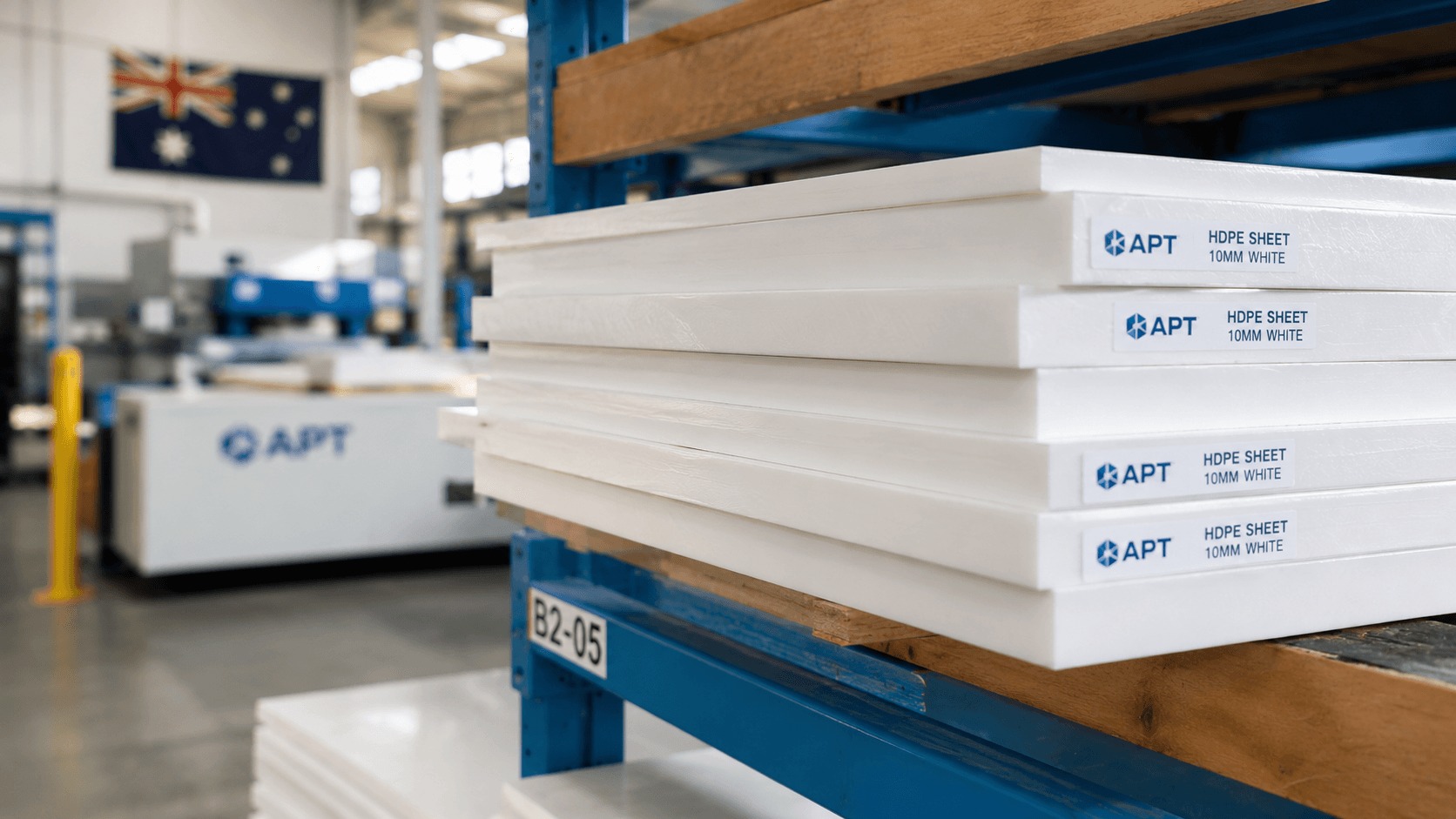
HDPE (High-Density Polyethylene) is a strong, chemical-resistant thermoplastic used across Australia for cutting boards, water tanks, marine fenders, signage backing, and industrial fabrication. It’s valued for being lightweight, UV-tolerant when stabilised, and resistant to moisture, impact, and most chemicals — making it one of the most versatile plastics supplied by fabricators like Associated Plastics Tasmania.
What Is HDPE Made From?
HDPE is a thermoplastic polymer made from petroleum, processed into a dense, tightly-packed molecular structure — hence “high-density.” That structure is what gives it strength and rigidity compared to softer plastics like LDPE (low-density polyethylene), while still remaining lightweight and easy to machine.
It’s typically supplied as flat sheet, rod, or block, and is one of the easiest plastics to CNC rout, drill, and weld — which is why fabricators across Australia use it for both one-off custom parts and production runs.
What Are the Key Properties of HDPE?
| Property | Detail |
|---|---|
| Density | ~0.93–0.97 g/cm³ (lightweight, floats in water) |
| Chemical resistance | Excellent against acids, alkalis, solvents |
| Moisture resistance | Fully waterproof, won’t absorb or rot |
| UV resistance | Good in UV-stabilised grades; standard grade degrades outdoors over time |
| Impact resistance | High — resists cracking and shattering |
| Food safety | Available in food-grade sheet (FDA/AS compliant) |
| Working temperature | Approx. -40°C to 80°C |
| Machinability | Cuts, routs, drills, and welds cleanly |
What Is HDPE Used For in Australia?
HDPE’s mix of strength, chemical resistance, and machinability makes it suited to a wide range of Australian industries:
- Food and hospitality — cutting boards, food prep surfaces, and splashbacks, thanks to food-grade, non-porous, bacteria-resistant grades
- Marine and boating — fender boards, dock bumpers, and boat fittings that need to resist saltwater and impact
- Signage and fabrication — durable backing panels and outdoor sign substrates in UV-stabilised grades
- Agriculture — chemical tank components, tray liners, and equipment guards resistant to fertilisers and chemicals
- Industrial and mining — wear strips, chute liners, and machine guarding where impact and abrasion resistance matter
- Water management — poly tanks, fittings, and water-contact components since HDPE doesn’t corrode or leach
- Playgrounds and outdoor furniture — UV-stabilised HDPE sheet for weather-resistant seating and fittings, since it won’t rot or splinter like timber
HDPE vs Other Plastics: How Does It Compare?
| Material | Best For | Weaker Than HDPE On |
|---|---|---|
| Acrylic | Optical clarity, signage, displays | Impact resistance, chemical resistance |
| Polypropylene | Chemical tanks, hinges, lighter loads | Rigidity, impact strength |
| PVC | Cost-effective signage, plumbing | UV stability, food safety |
| Polycarbonate | Extreme impact strength, glazing | Cost, chemical resistance to some solvents |
HDPE sits in the middle ground: not as optically clear as acrylic, not as impact-resistant as polycarbonate, but more chemically resistant and food-safe than most alternatives — which is why it’s the default choice for food prep surfaces and outdoor fittings across the country.
Is HDPE Food Safe?
Yes. Food-grade HDPE is non-porous, doesn’t harbour bacteria the way timber can, and is compliant with Australian food-contact standards. It’s the standard material behind most commercial cutting boards and food prep surfaces in Australian kitchens.
Does HDPE Need UV Protection for Outdoor Use?
Standard HDPE will gradually chalk and become brittle under Australia’s harsh UV conditions. For any outdoor application — signage, fittings, furniture — UV-stabilised HDPE grades are recommended to maintain strength and appearance long-term.
Get HDPE Cut to Size in Tasmania
Associated Plastics Tasmania stocks and fabricates HDPE sheet, rod, and custom parts for businesses and tradespeople across Tasmania and Australia-wide. Whether you need food-grade cutting boards, marine fenders, chemical-resistant tank components, or UV-stabilised outdoor fittings, our team can cut, machine, and weld HDPE to your exact specification — with fast turnaround from our Tasmanian workshop.
Get a quote from Associated Plastics Tasmania →
Frequently Asked Questions
Is HDPE stronger than acrylic?
HDPE has significantly better impact resistance than acrylic, though acrylic offers superior clarity for display and glazing applications.
Can HDPE be recycled?
Yes, HDPE is one of the most widely recycled plastics in Australia (recycling code 2) and can be reprocessed into new products.
What thickness does HDPE sheet come in?
HDPE sheet is commonly available from around 3mm up to 50mm+, depending on the application and load requirements.
Can HDPE be welded?
Yes, HDPE welds cleanly using plastic welding techniques, making it suitable for tanks, liners, and custom fabricated parts.
Is HDPE better than timber for outdoor furniture?
For weather resistance, HDPE outperforms timber — it won’t rot, splinter, or need repainting, though timber offers a different aesthetic.