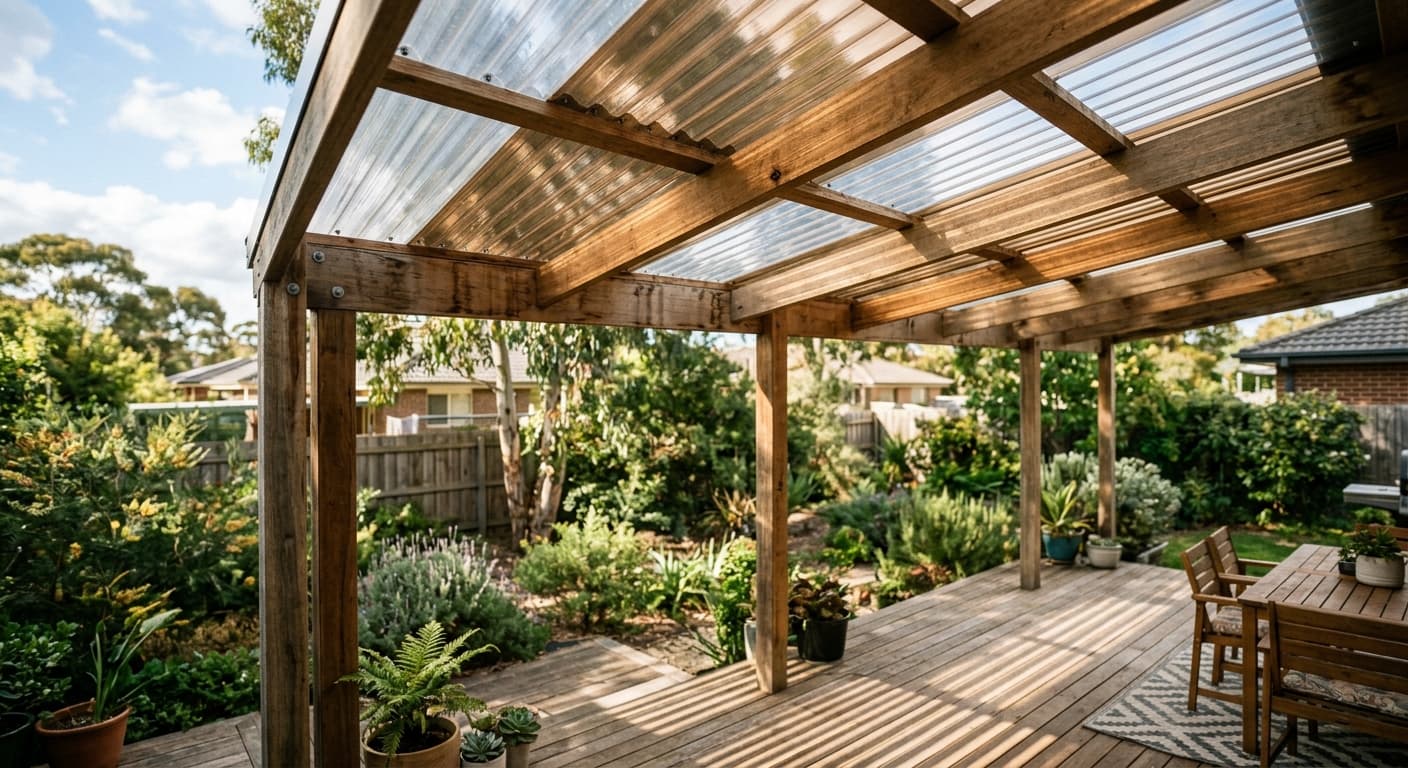
Choosing polycarbonate roofing comes down to two decisions: the colour (or tint), which controls how much light and heat reach the space below, and the profile, which controls how the sheet joins to your existing roof and how far it can span. Clear passes the most light at around 85 to 90 per cent but offers the least glare control. Opal and diffused whites soften light to roughly 40 to 60 per cent transmission and cut glare noticeably. Grey and smoke tints reduce both light and solar heat, and bronze does the same with a warm cast. For profile, match whatever is already on your roof: corrugated for classic corrugated iron, Greca or Trimdek style for a squarer rib, and twin wall or multiwall for insulated flat glazing.
This guide walks through each choice in the order you actually have to make it, with the span and fixing rules that determine whether the roof survives its first serious Australian summer.
Start with the profile, not the colour
It is tempting to pick a colour first because that is the visible decision, but profile is the constraint. A polycarbonate sheet has to sit on the same purlins and interlock with the same ribs as the metal roofing around it. Get the profile wrong and no amount of silicone will make the joint watertight.
Corrugated
The traditional sinusoidal wave, matching classic corrugated iron. Australian corrugated polycarbonate is typically made to a 76mm pitch so it laps directly into standard corrugated steel sheeting. Sheet widths are usually around 860mm with an effective cover of about 760mm once you allow for the side lap. This is the default choice for pergolas, verandah infills, carports and patching a section of an existing corrugated roof with a light panel.
Corrugated is the most forgiving profile for curved installations. It will take a gentle cold curve over a bullnose verandah without special tooling, which is why you see it on so many older Australian homes.
Greca and trapezoidal profiles
Greca is a squarer, more angular rib, and it sits in the same family as the trapezoidal steel profiles sold under names like Trimdek and Spandek. The flat pans between ribs shed water fast and the deeper rib gives the sheet more stiffness, which generally means it can span slightly further between purlins than corrugated of the same thickness.
Use a trapezoidal polycarbonate when the surrounding roof is trapezoidal steel. Mixing a corrugated polycarbonate panel into a Trimdek roof is a common and expensive mistake, because the ribs will not align and the lap will leak.
Twin wall and multiwall
Twin wall is a flat sheet with two skins separated by internal ribs, creating sealed air channels. Those air pockets do real insulating work, so twin wall is the option for a space you want to keep usable in both a Hobart winter and a Queensland summer: enclosed patios, conservatories, pool enclosures, greenhouses and skylights.
Multiwall extends the idea to three, five or more skins for progressively better thermal performance. The trade-off is cost, a slightly hazier appearance, and a more demanding installation. The flutes must run down the slope so condensation can drain, and the open ends have to be sealed with breather tape and end caps, or dust and algae will colonise the channels and you will be looking at green stripes within a couple of seasons.
Solid flat sheet
Solid polycarbonate sheet, the glass-like variety, is used for machine guards, safety glazing, sneeze screens and windows rather than roofing. It has the impact resistance polycarbonate is famous for but none of the profiled sheet’s stiffness, so it needs a glazing bar system rather than direct fixing through the face.
Polycarbonate roofing colours and what each one actually does
Every colour is a compromise between light, glare and heat. Two numbers matter. Light transmission is the percentage of visible light that passes through. Solar heat gain is how much of the sun’s total energy comes through, and it does not track light transmission neatly, because a good deal of solar energy arrives as infrared you cannot see.
That mismatch is the single most useful thing to understand here. A diffused white sheet can pass a lot of light while feeling far cooler underneath than a clear sheet, because the diffusion scatters the beam and the pigment absorbs some infrared. Picking purely on brightness will leave you with a hot space.
| Colour | Typical light transmission | Best for | Watch out for |
|---|---|---|---|
| Clear | Approx 85 to 90 per cent | Maximum daylight into dark areas, side windows, shade house sections, light wells | Harsh glare, hot spots, and it shows every leaf and bit of dust on the surface |
| Opal or white diffused | Approx 40 to 60 per cent | Patios and outdoor living areas where you want brightness without glare | Reduces light noticeably in already shaded southern aspects |
| Grey or smoke | Approx 20 to 35 per cent | Hot northern and western aspects, carports, anywhere heat is the main complaint | Can make a covered area feel gloomy on overcast days |
| Bronze | Approx 20 to 35 per cent | Heat control with a warm tone, matching brick and timber homes | Casts a distinctly amber light that some people dislike for entertaining areas |
| Solar or heat-reflective tints | Approx 15 to 30 per cent | Extreme heat loads where infrared rejection matters more than light | Higher cost, smaller range of profiles and lengths |
A practical way to choose the tint
Work backwards from the problem you are solving.
- The space is too dark. Clear, or opal if glare is also a concern. This is the usual answer for a narrow side passage, a light panel in a shed roof, or a section of an existing dark roof.
- The space is bright enough but unbearably hot. Grey, bronze or a heat-reflective tint. Anything on a north or west face in mainland Australia should start here.
- The space is comfortable but the glare is unpleasant. Opal or diffused white. Diffusion is what kills glare, not darkness, and diffused sheets keep the space feeling bright.
- You want to hide what is on the roof. Darker and more opaque colours conceal leaf litter, cabling and the general grime that collects on a horizontal surface. Clear shows everything.
- You need to match the house. Bronze suits brick and warm-toned homes. Grey suits Colorbond greys and modern monochrome palettes. Opal is close to neutral against most colours.
Consider a mixed approach on larger roofs. A run of grey over the seating area with a clear or opal panel over a section that needs light is a very common and sensible layout, and there is no technical reason you cannot mix colours in the same profile.
Laserlite, Suntuf and Alsynite: what the brand names mean
Australians tend to search by brand rather than by material, so it is worth knowing what sits behind the names.
Laserlite is a polycarbonate roofing range from Stratco, with Laserlite 3000 as the flagship corrugated product. It is sold in the usual colour set of clear, opal, grey and bronze along with several proprietary shades, and it comes in corrugated and Greca profiles.
Suntuf is a profiled polycarbonate range from Palram, widely stocked through hardware retailers, in a similar spread of clear, white opal, diffused white, solar ice and grey.
Alsynite is a long-established Australian name in translucent roofing. Historically it referred to fibreglass reinforced polyester sheeting, and the name is still widely used generically for translucent roofing even where the product is polycarbonate. Worth checking which material you are actually being quoted on, because fibreglass and polycarbonate age very differently.
These are brand names within a category, not different materials. All profiled polycarbonate roofing sold for Australian conditions should carry a co-extruded UV protective layer on the weather face. That layer is the single most important spec on the sheet, because bare polycarbonate yellows and embrittles under Australian UV within a few years. It is also why the sheet has a marked side and must be installed the right way up.
If you want the broader case for the material itself, we have covered that separately in 10 benefits of polycarbonate roofing for Australian climate conditions.
Thickness, span and fixing
Colour has no effect on structural performance. Thickness, profile and purlin spacing do all the work.
Thickness
Profiled polycarbonate roofing is commonly supplied around 0.8mm for general domestic use, with heavier gauges available where spans are longer or the roof is exposed to hail. Twin wall is specified by overall sheet thickness instead, typically 4mm through 16mm, with the thicker sheets giving better insulation and longer allowable spans.
As a rule, if you are unsure between two thicknesses, the heavier sheet is the cheaper decision over ten years. The cost difference at purchase is small next to the cost of re-roofing after a hail event.
Span
Polycarbonate needs continuous support from purlins or battens. It is not self-supporting across open framing. Manufacturers publish span tables and those tables are the authority for your specific product, but the typical domestic guidance for corrugated sheeting is an end span of roughly 800mm and mid spans of roughly 1000mm. Trapezoidal profiles usually allow a little more, twin wall depends heavily on thickness.
Reduce those spans in high wind regions and in areas exposed to snow load. Tasmania’s highland areas and alpine Victoria both need more conservative spacing than a Brisbane back patio. Wind region classifications come from AS/NZS 1170.2, published by Standards Australia, and roof cladding for habitable structures also has to satisfy the National Construction Code. Most domestic pergolas and carports are exempt or fall under simplified provisions, but check with your council before assuming so, particularly for anything attached to the house.
Fixing
Fixing is where most DIY polycarbonate roofs fail, and the failures are almost always the same three mistakes.
- Fix through the crest, not the valley. On roofing, screws go through the high point of the corrugation with a neoprene washer. Valley fixing puts the fastener in the water path. The exception is vertical wall cladding, where valley fixing is used.
- Pre-drill oversized holes. Polycarbonate has a high coefficient of thermal expansion and a long sheet will move several millimetres between a cold night and a hot afternoon. Drill the fixing hole around 3mm larger than the screw shank so the sheet can slide. Screwing tight into a snug hole causes the sheet to buckle, then crack around the fastener, then leak.
- Do not overtighten. The washer should compress just enough to seal and no further. A dimpled, dished sheet around every screw is the sign of an overtightened roof.
Typical fixing density is around six to seven fasteners per metre across the sheet, generally every second corrugation on the first and last purlin and every third corrugation on intermediate purlins. Follow your product’s installation guide, since patterns vary by profile.
Two more details that matter. Maintain the minimum roof pitch specified for the profile, usually around five degrees for corrugated, because polycarbonate holds water on a flat run and any pooling will find its way through a lap. And never walk directly on the sheeting. Use a crawl board spanning at least two purlins. Polycarbonate is extremely impact resistant but it is not designed to carry a point load between supports, and the manufacturer’s warranty will not cover a foot through the roof.
Longevity and maintenance
A well-installed, UV-protected polycarbonate roof should give ten to twenty years of service in Australian conditions, and the better products carry warranties in that range against excessive yellowing and loss of light transmission. What shortens that life is almost always installation error or cleaning error rather than the material.
Clean with warm water, a soft cloth and mild detergent. Never use solvent based cleaners, methylated spirits, acetone or abrasive pads. Solvents cause crazing, a network of fine surface cracks that permanently clouds the sheet and creates stress points. Rinse leaf litter off before it composts into an acidic mat, particularly under eucalypts.
For the full material picture, including chemical resistance and machining, see our polycarbonate material guide, and you can browse profiles, colours and lengths in our polycarbonate roofing range.
Getting the quantity right
Order on effective cover, not sheet width. A corrugated sheet around 860mm wide covers about 760mm once lapped, so a 4 metre wide opening needs six sheets, not five. Allow a modest overhang past the gutter line, usually 50 to 70mm, so water discharges cleanly rather than tracking back under the sheet.
Sheets are commonly stocked in lengths from 1.8 metres up to 7.2 metres in 600mm increments, and can be cut to order. Buying a single long sheet rather than lapping two shorter ones removes a joint, and every joint you remove is one fewer place for the roof to leak.
FAQ
What is the best colour for polycarbonate roofing in Australia?
For most outdoor living areas, opal or diffused white is the best all-round choice because it keeps the space bright while cutting glare. If heat is the main problem, particularly on north or west facing structures, choose grey, bronze or a heat-reflective tint. Choose clear only where maximum light matters more than glare and heat, such as a narrow side passage or a light panel in an otherwise dark shed roof.
Which polycarbonate colour is coolest underneath?
Darker and heat-reflective tints such as grey, smoke and bronze reject the most solar energy and will feel coolest. Diffused white also performs better than its light transmission figure suggests, because scattering the light removes the concentrated hot spots you get under clear sheeting. Clear is the hottest option in direct sun.
What colours does Laserlite 3000 come in?
Laserlite 3000 is offered in the standard translucent roofing set of clear, opal, grey and bronze along with additional proprietary shades, in corrugated and Greca profiles. Ranges and shade names change from time to time, so confirm the current colour list and stocked lengths at the time of ordering.
What are the downsides of polycarbonate roofing?
The main drawbacks are noise in heavy rain, significant thermal expansion that must be allowed for at every fixing, surface scratching more easily than glass, and sensitivity to solvent based cleaners. It also needs continuous purlin support rather than spanning open framing. None of these are dealbreakers, but each one has to be designed for rather than discovered later.
Can you mix polycarbonate colours on the same roof?
Yes, provided you stay within the same profile and thickness so the sheets lap correctly. Running grey over a seating area and clear or opal over a section that needs daylight is a common and effective approach, and there is no structural reason not to do it.
Can you walk on polycarbonate roofing?
No. Always use a crawl board or plank spanning at least two purlins and distribute your weight across it. Polycarbonate resists impact very well but is not rated to carry a concentrated point load between supports, and walking directly on sheeting will typically void the warranty.