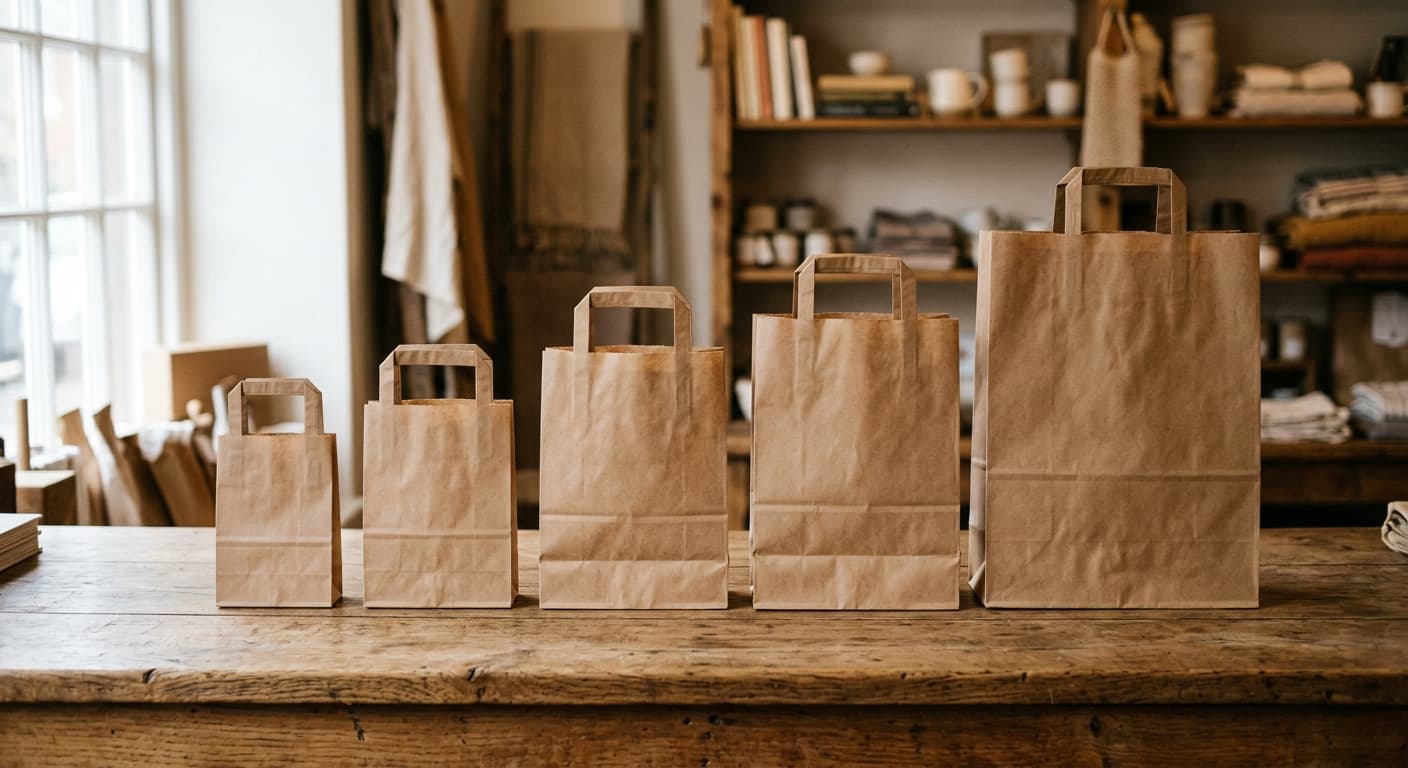
Australian paper bags are sized in millimetres, written as width x height plus the gusset, and there is no single national standard. The practical answer most people are searching for is this: an A3 sheet measures 297 x 420 mm, so you need a bag with an opening of at least 300 mm across and around 420 mm deep. In a standard Australian kraft range that means a Midi bag (420 x 310 + 110 mm) at the absolute minimum, or a Medium bag (480 x 340 + 90 mm) if you want the print to slide in without bending a corner.
Everything smaller, including the popular Small size at 350 x 260 mm, will not take an A3 print flat no matter which way you turn it.
That is the short version. The rest of this guide covers the full size ladder, what the numbered flat bag system actually means, which sizes suit which products, and how to work out what to order when you are buying bulk paper bags for a retail counter, a market stall or a food outlet.
How Australian paper bag sizes are written
Three numbers describe most paper bags sold in Australia:
- Width, measured across the front face of the bag at the opening.
- Height, measured from the base to the top edge, not including handles.
- Gusset, the folded side or base panel that lets the bag expand. This is the number after the plus sign, as in 480 x 340 + 90 mm.
The gusset is the one people forget, and it is the one that decides whether a boxed item actually fits. A bag with a 50 mm gusset will not take a 90 mm deep cake box, regardless of how tall it is. If you are packing anything with real depth, check the gusset before you check the height.
Two other conventions turn up regularly. Flat paper bags are sold by a traditional number system inherited from the old imperial trade sizes, so you will see “2 Long” and “4 Square” rather than dimensions. And carry bags are often given names such as Runt, Toddler, Junior, Midi and Medium, which sound arbitrary but map to a consistent size ladder across most Australian suppliers.
Paper bag size chart
Kraft and white carry bag sizes
This is the standard twisted handle carry bag range, available in both brown kraft and white. These are the sizes you see on retail counters, at markets and in gift stores.
| Size name | Dimensions (mm) | Typical use |
|---|---|---|
| Mini Gift | 100 x 150 + 70 | Jewellery, gift cards, small candles, wedding favours |
| Runt | 165 x 140 + 75 | Cosmetics, confectionery, small hardware items |
| Toddler | 200 x 170 + 100 | Coffee beans, soap, single takeaway items |
| Baby | 265 x 160 + 50 | Bottles, narrow deli items, greeting cards |
| Junior | 290 x 170 + 100 | Books, boxed gifts, boutique retail |
| Small | 350 x 260 + 90 | Clothing, general retail, market stall purchases |
| Midi | 420 x 310 + 110 | A3 prints, homewares, multiple items |
| Medium | 480 x 340 + 90 | Posters, calendars, bulky clothing, hampers |
| Large | 500 x 450 + 125 | Checkout replacement, groceries, large gifts |
Flat paper bag sizes by number
Flat bags have no gusset and no handles. They are the cheapest bag per unit and the standard choice for bakeries, newsagents, market stalls and anywhere the item is thin. The number refers to the traditional size, and “Long” or “Square” describes the proportion.
| Bag number | Dimensions (mm) | Typical use |
|---|---|---|
| 1/4 Long | 120 x 100 | Loose confectionery, seeds, small fixings |
| 1/2 Long | 150 x 117 | Lollies, jewellery, badges |
| 1 Long | 170 x 140 | Pastries, single biscuits, stationery |
| 1 Square | 180 x 180 | Muffins, small hardware, postcards |
| 2 Square | 210 x 203 | Sandwiches, wrapped rolls, greeting cards |
| 2 Long | 240 x 180 | Bread rolls, deli items, paperbacks |
| 4 Square | 285 x 275 | Larger baked goods, A4 documents |
| 4 Long | 285 x 240 | Magazines, A4 prints, produce |
| 6 Square | 300 x 300 | Cakes, larger produce, records |
| 6 Long | 360 x 240 | Loaves, long produce, framed prints |
| 8 Long | 415 x 274 | The largest standard flat bag, oversized documents |
SOS flat bottom bag sizes
SOS bags have a square base that lets them stand upright on a bench without being held. That single feature is why they dominate food service, takeaway and delivery. The two SUP sizes are the larger handled versions used as singlet bag replacements.
| Size | Dimensions (mm) | Typical use |
|---|---|---|
| SOS No.1 | 210 x 90 + 50 | Chips, single serves, counter snacks |
| SOS No.2 | 260 x 130 + 80 | Burgers, wrapped rolls, small takeaway orders |
| SOS No.3 | 295 x 160 + 85 | Full takeaway meals, bakery boxes |
| SUP1 | 390 x 240 + 120 | Multi-item delivery orders, gift packaging |
| SUP2 | 430 x 300 + 175 | Large delivery orders, singlet bag replacement |
You can see the full stocked range, pricing and carton quantities on our paper bags category page.
What size paper bag fits A3?
A3 paper is 297 x 420 mm under the international ISO 216 standard, exactly twice the area of A4. To carry an A3 sheet, print or poster without folding it, the bag needs to clear both of those numbers.
The Midi carry bag at 420 x 310 + 110 mm is the smallest bag in the standard Australian range that will do it. A3 fits either orientation: 420 mm against the 420 mm dimension with 310 mm of clearance for the 297 mm side. It works, but it works with 13 mm to spare, which is not much when you are sliding a mounted print in.
The Medium at 480 x 340 + 90 mm is the size most print shops, galleries and framers actually order. It leaves 60 mm of head height and 43 mm across, so the print goes in cleanly, the top can be folded over, and there is room for tissue or a backing board.
Two things to watch. First, if the artwork is mounted or backed, the extra thickness eats into the gusset, so a bag with a 110 mm or 125 mm gusset is safer than a 90 mm one. Second, A3 is often quoted as an “A3 bag size” in retail listings when the seller means a bag that holds an A3 item, not a bag that measures 297 x 420 mm. Always check the actual millimetres.
For the record, the related sizes are A4 at 210 x 297 mm, A2 at 420 x 594 mm and A1 at 594 x 841 mm. A 4 Long or 4 Square flat bag handles A4 comfortably. A2 and larger generally need a purpose-made poster tube or a flat carton rather than a bag.
Small paper sacks and where they earn their place
“Small paper sacks” usually means the flat and SOS bags under about 300 mm tall. They do a lot of quiet work:
- Bulk foods and produce. A 1 Long or 2 Long flat bag is the standard for loose nuts, dried fruit, mushrooms and bakery items. Paper breathes, which stops condensation the way a sealed plastic bag does not.
- Hardware and trade counters. Fixings, fittings and small parts go into 1/4 Long and 1/2 Long bags that can be written on with a marker.
- Pharmacy and dispensary. White flat bags in the 1 Long to 2 Square range are the norm because they take a printed label cleanly.
- Cafes and food trucks. SOS No.1 and No.2 stand upright while you fill them one-handed during a rush, which is the whole point of the flat base.
If you are packing anything wet, oily or heavy, a paper bag is not always the right answer. Our plastic bags range covers the sealed, waterproof and heavy-duty applications where paper will fail, including produce bags, gusseted liners and heavy-duty sacks.
Kraft, white or laminated
Once you have the size, the stock is the next decision.
Brown kraft is the default. It is the strongest paper for its weight, the cheapest per unit in bulk, recyclable in standard kerbside collection and compostable. Unbleached kraft also reads as environmentally considered, which matters for a lot of Australian retail customers.
White paper costs slightly more and is marginally less strong at the same gsm, because the bleaching process shortens the fibres. What you get in return is a surface that prints far more vividly and a cleaner look on a retail counter. If you are stamping or stickering your logo, white shows it better.
Laminated bags carry a thin film that adds moisture resistance and a gloss or matte finish. They are the choice for wine, gifts and boutique retail where the bag is part of the presentation. The trade off is that lamination complicates recycling, so check your local kerbside rules before committing to a laminated line as your everyday bag.
Australia’s national packaging targets, administered by the Australian Packaging Covenant Organisation, push all packaging towards being reusable, recyclable or compostable. Plain uncoated kraft already meets that comfortably, which is one reason so many businesses moved to it when the state-by-state single-use plastic bag bans came in.
Buying bulk paper bags
Paper bags are priced per pack, and the breaks at carton quantity are steep. Smaller sizes generally come in cartons of 500 or 1000, larger carry bags in cartons of 250. A business going through a few hundred bags a week will usually halve its unit cost by moving from single packs to cartons.
A few practical rules for working out an order:
- Carry two sizes deep, the rest shallow. Most retailers find 70 to 80 per cent of transactions fit two sizes. Order those by the carton and keep single packs of the rest.
- Size up rather than down for gifts. A slightly oversized bag with tissue looks considered. A bag the item barely fits into looks like a mistake.
- Match the gusset to your deepest regular item. Measure the widest box you sell and add 10 mm.
- Set a standing order. Paper stock is bulky and lead times move. A repeating monthly order removes the scramble.
Associated Plastics has supplied packaging to Australian retailers, cafes and producers since 1979. We hold stock in Hobart and ship Australia-wide, and we are happy to work out a size range with you if you tell us what you are packing. Alongside packaging we also do custom fabrication for retail displays, stands and point-of-sale fittings, so a single supplier can cover both the bag and the bench it sits on.
FAQ
What size paper bag fits an A3 print?
A3 is 297 x 420 mm, so you need a bag measuring at least 310 mm across and 420 mm high. The Midi carry bag at 420 x 310 + 110 mm is the smallest that works, and the Medium at 480 x 340 + 90 mm is the comfortable choice if the print is mounted or you want to fold the top over.
What are the standard sizes of paper bags in Australia?
There is no legislated standard, but the trade has settled on a consistent ladder. Carry bags run from Mini Gift at 100 x 150 mm up to Large at 500 x 450 mm. Flat bags use the numbered system from 1/4 Long at 120 x 100 mm through to 8 Long at 415 x 274 mm. SOS flat bottom bags run from No.1 at 210 x 90 mm to SUP2 at 430 x 300 mm.
Is an A3 bag bigger than an A4 bag?
Yes, twice the area. A4 is 210 x 297 mm and A3 is 297 x 420 mm. In bag terms, an A4 item fits a 4 Long or 4 Square flat bag, while an A3 item needs a Midi or Medium carry bag.
What does the number after the plus sign mean?
That is the gusset, the folded side or base panel that lets the bag expand to hold depth. A bag listed as 480 x 340 + 90 mm is 480 mm wide, 340 mm high and expands to 90 mm deep at the base. It is the number that determines whether a boxed item will fit.
How many paper bags come in a carton?
Typically 1000 for the smallest flat bags, 500 for mid-range sizes and 250 for larger carry bags. Carton pricing is significantly cheaper per bag than single packs, which is why most regular users set up a standing order on their two highest-volume sizes.
Are brown paper bags compostable?
Plain uncoated brown kraft is both recyclable and home compostable. Laminated and coated bags are not, because the film has to be separated from the paper. If compostability matters to your customers, stay with plain kraft and use a paper label rather than a plastic sticker.